Fernando Mendes: ScanQueue — QR Queues for Real Businesses
Australian founder who built a simple QR virtual queue system used by cafés, barbers, clinics and events across 60+ countries.
- MRR
- Paid plans from $49
- Users
- Businesses in 60+ countries
- Founded
- 2025
- Team
- Solo / small team
- Stack
- Web, SMS, WhatsApp
What is ScanQueue and why does it exist?
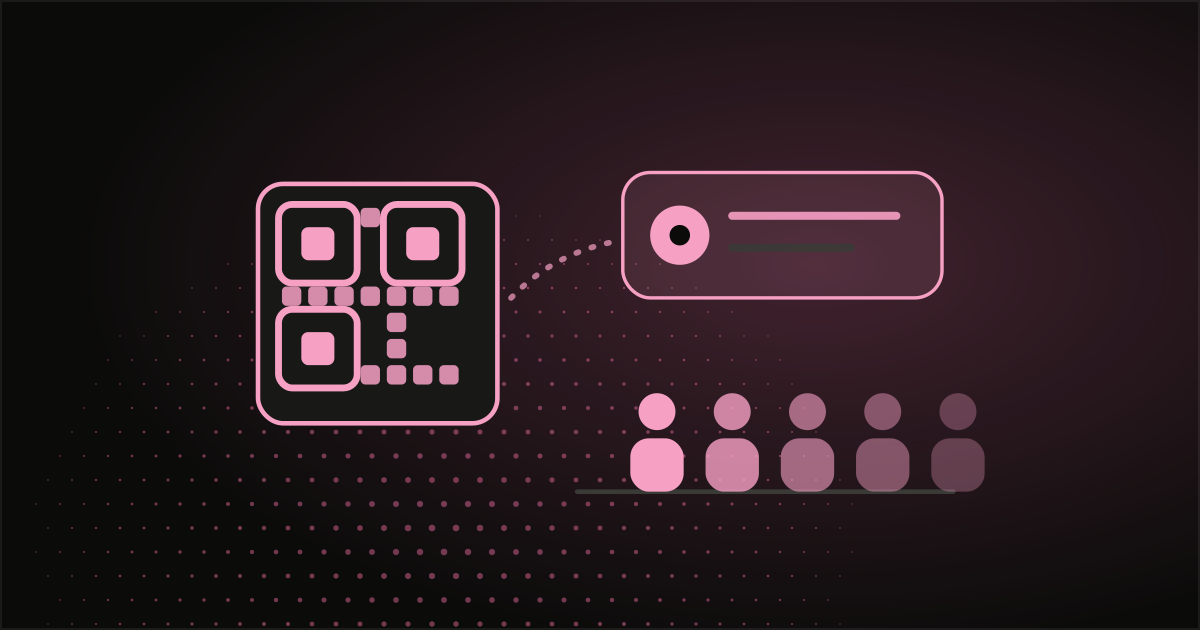
ScanQueue is cloud queue-management software for walk-in businesses. Customers scan a QR code at the door or counter, join a virtual queue on their phone, see their live position, and receive an SMS, WhatsApp, or push notification when it is their turn. No app download is required. Staff manage the queue from a dashboard or mobile app.
I founded the company in 2025 on the Gold Coast in Australia and operate it through Tugadot Pty Ltd. The product is used by cafés, barbershops, clinics, retail, and events in more than sixty countries. There is a free starter plan and paid plans that begin at $49 per month, with higher tiers for multi-location and higher message volume.
The problem is simple and still widespread. Many small businesses still use paper lists, shouted names, or expensive hardware systems. Existing software was often priced for larger venues or required installations that small operators did not want. I wanted something that could be live in about five minutes, worked entirely in the browser for customers, and notified people reliably.
How does the product actually work day to day?
A business signs up, creates a queue, and prints or displays its unique QR code. Customers scan with their phone camera, enter a name or party size if needed, and join. Their phone shows live position and estimated wait. When staff call the next customer, the system sends the chosen notification channel. Staff can also add walk-ins manually, reorder, mark no-shows, and view basic analytics.
Optional features include kiosk mode, custom check-in forms, multi-location support, online booking that feeds into the same queue, and capacity counting for venues with limits. The design goal is always the same: remove friction for both the business and the customer.
How do you acquire and keep customers?
Word of mouth between business owners is strong. When one café or barbershop uses it successfully, nearby businesses hear about it. Local Facebook groups and industry conversations help. SEO around terms such as QR queue, virtual waitlist, and vertical-specific phrases (barbershop queue system, clinic waitlist, etc.) brings intent traffic.
I have kept paid acquisition limited. The product has to sell itself through clarity and speed of setup. Support is email-based on every plan, including free, which keeps the relationship direct and the feedback loop short.
Retention comes from reliability and simplicity. If the queue works during the busy Saturday rush, the business stays. If notifications fail or the interface confuses staff, they leave. That forces continuous attention to the core experience rather than feature bloat.
What has been harder than expected?
Message costs and deliverability vary by country. SMS is expensive or restricted in some markets; WhatsApp is preferred in others. Building flexible notification logic while keeping pricing understandable is an ongoing balance.
Multi-location and higher-volume customers need better reporting and controls without making the product feel enterprise-heavy for the single-location café that is still the typical user. Serving both ends of that spectrum with one codebase is a product-design challenge.
What is next?
Deeper WhatsApp-first flows for markets where SMS is costly. Stronger multi-location tools and analytics for chains and event operators. Continued focus on the five-minute setup promise. The competitive advantage is still simplicity: a business can be live before the lunch rush starts, and customers never have to install anything.
For other indie founders the main lesson is that “boring” local-business problems still have room for clean software. You do not need a new category. You need a version that is dramatically easier than what operators currently tolerate.
More stories
 Meta
Meta
The Portfolio Pattern: Why Top Indie Makers Run Multiple Products
 Product Origin
Marc Lou: The Week ShipFast Changed Everything
 Mature
Pieter Levels (Part 2): Nomad List & Remote OK — The Original Audience Engine
 Profitable
Jon Yongfook: Bannerbear — Automated Image Generation to Solid ARR
 Educator + Builder
Arvid Kahl: From FeedbackPanda Exit to Teaching Bootstrappers
 Scale
Scale
Danny Postma: HeadshotPro — AI Headshots to Six-Figure Months
 Scale
Scale
Tony Dinh: TypingMind from 5-Day Build to $130K+/mo
 Mature Solo
Pieter Levels: Photo AI to $100K+/mo with One PHP File
 Portfolio Scale