AI Search Crawlers for Independent Publishers: What to Allow and What to Measure
A practical, source-backed guide to distinguishing AI search crawlers from training crawlers, checking robots.txt, and measuring whether AI discovery brings readers.
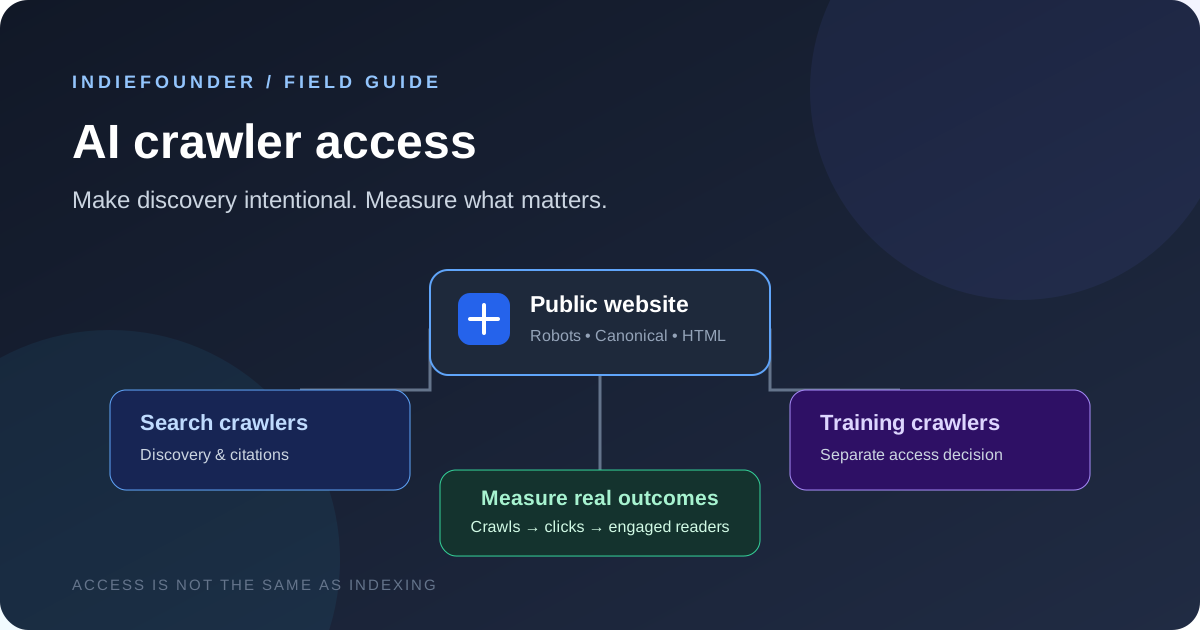
AI assistants can only reliably discover public web pages when their systems can access those pages. But allowing every crawler is not a complete AI-visibility strategy, and a crawler visit does not guarantee that a page will be cited in an answer.
For an independent publisher, the practical goal is narrower: make useful public pages discoverable, understand which crawler is requesting them, and measure whether the resulting visibility sends engaged readers.
Search crawling and model training are different choices
Some providers identify separate crawlers for search-related discovery and model training. OpenAI documents OAI-SearchBot for search and GPTBot for potential training use. Anthropic likewise documents separate crawlers, including ClaudeBot and Claude-SearchBot. Their purposes and policies can change, so check the provider’s current documentation before changing access rules.
This distinction lets a publisher make a deliberate decision rather than treating “AI bots” as one category. Choose access based on your content rights, business goals, and provider terms. Do not assume that allowing a crawler guarantees indexing, citations, or traffic.
A practical access audit
Start with the root robots.txt file and review rules for each crawler you care about. Check whether public editorial pages are accidentally disallowed. Also inspect page-level robots directives, canonical URLs, HTTP status codes, and authentication barriers.
For a content site, public articles, topic hubs, original research, author pages, and editorial policies are usually the most useful discovery targets. A private reading list, account page, or user-specific dashboard should not be exposed just to make a site more crawlable.
Remember that robots.txt is a crawler instruction, not access control. Do not put confidential information on a public server and rely on robots rules to protect it.
Make the content useful to retrieve
Crawler access is only the plumbing. Pages still need a clear purpose and substance that answers a real question.
A useful technical article should define the problem near the beginning, explain the decision criteria, distinguish verified facts from opinion, link to primary documentation, and state when information was checked. Use descriptive headings and keep important content available as readable HTML rather than hiding everything behind a client-side interaction.
For original research, explain the method and limitations. If you have not run a benchmark, do not present invented numbers as results. If a page discusses product pricing or feature availability, link to the vendor and mark the date checked because those details can change.
Measure visits, not just bot activity
Server logs can help distinguish crawler requests from people visiting the site. Verify crawler identity using the provider’s published methods; a user-agent string alone can be spoofed. Analytics can then measure referrals and engagement where the visitor source is available.
Track three different outcomes separately:
- Crawl activity: verified requests to useful public URLs.
- Search visibility: impressions, clicks, CTR, and position in search reporting tools.
- Audience value: referral sessions, engaged sessions, newsletter sign-ups, and product submissions.
These metrics answer different questions. A crawl can happen without an index entry; an index entry can exist without impressions; and a citation can occur without a measurable referral. Do not treat one as proof of the others.
A small experiment for indie publishers
Choose five high-value pages and record their current status. Confirm that each is public, returns a successful response, has a self-consistent canonical URL, and is not accidentally marked noindex. Review relevant crawler rules, then add contextual links from related articles and topic hubs.
Over the following weeks, monitor verified crawler requests, Search Console performance, referral sources, and conversions. Compare results with the baseline rather than attributing every traffic change to one technical edit.
The takeaway
AI discovery is not a magic metadata trick. It combines sensible access decisions, crawlable technical foundations, original and trustworthy content, and measurement that separates bot activity from human outcomes. Start with a few valuable pages, keep a record of changes, and let evidence guide the next iteration.