How to Test SaaS Pricing Without Fooling Yourself
A practical experiment plan for indie SaaS founders: measure willingness to pay, contribution margin, activation, and retention before declaring a pricing winner.
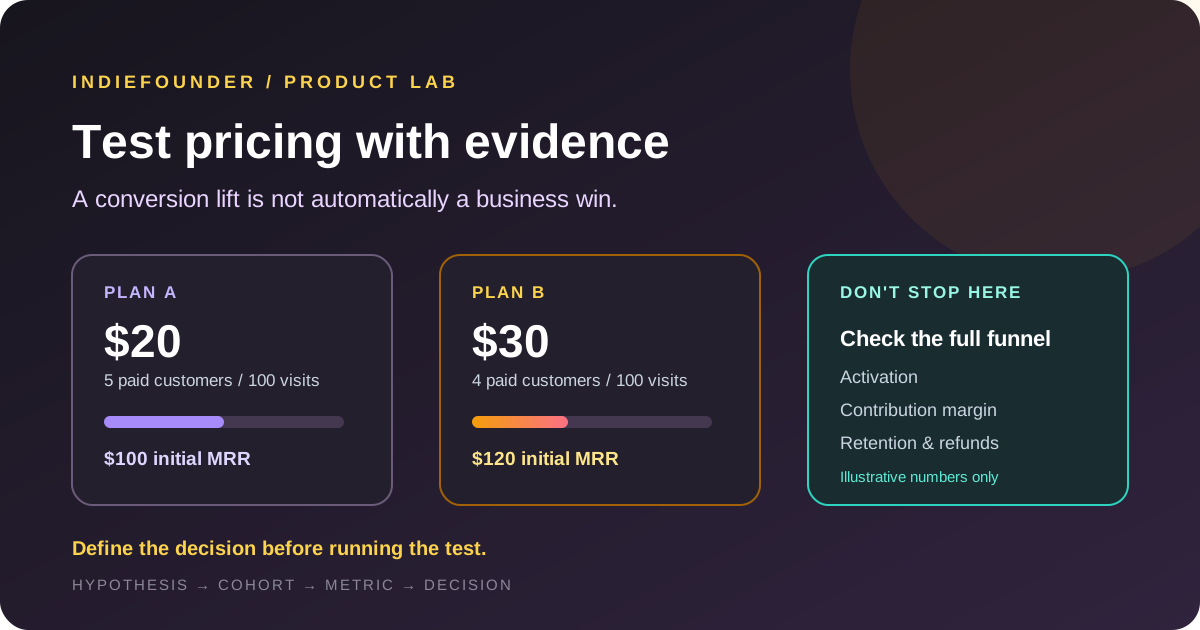
Pricing experiments are easy to misread. A new plan may produce more sign-ups because it is cheaper, while producing fewer paying customers or attracting users who churn quickly. A higher price may reduce conversion but improve gross profit per customer. Neither result is enough by itself to declare a winner.
The purpose of a pricing test is to learn whether a particular offer attracts the right customers at sustainable economics—not to maximize one headline metric.
Start with the decision, not the price
Write down the business decision before changing the page. Are you testing a monthly price, an annual discount, a usage limit, a free trial, or a feature boundary? Change one major variable at a time when practical, and record the audience and period.
Define the primary outcome in advance. Depending on the product, that may be paid conversion, gross profit per qualified visitor, trial-to-paid conversion, or retained revenue after a defined period. Keep guardrail metrics such as refunds, support burden, activation, and churn visible.
Use a funnel, not just a checkout rate
Track each stage with a consistent denominator:
- Qualified visitors who see the offer.
- Visitors who start sign-up or a trial.
- Users who reach the product’s activation milestone.
- Users who become paying customers.
- Customers who remain active or renew.
A price that increases sign-ups but reduces activation may not improve the business. A conversion rate is only interpretable when you know what counts as a conversion and which visitors are included.
Calculate contribution, not just revenue
For a simple cohort, calculate collected revenue minus variable costs that scale with serving that cohort. For AI products, those costs may include model usage, retrieval, storage, payment processing, and support. For other SaaS products, infrastructure and service costs may dominate.
Compare contribution per qualified visitor or per acquired customer over a fixed observation window. Do not call early revenue “lifetime value.” Lifetime value estimates depend on retention assumptions and can be very unstable when the product has only a short history.
A small hypothetical example illustrates the trade-off. Suppose Plan A converts 5 of 100 qualified visitors at $20 per month, while Plan B converts 4 of 100 at $30 per month. Initial monthly recurring revenue from that cohort is $100 for A and $120 for B, before costs and churn. That arithmetic alone does not establish a winner: you still need to examine refunds, serving costs, activation, retention, and whether the cohorts are comparable.
Avoid common experiment traps
Changing several things at once. If the price, copy, trial length, and feature limits all change, the result does not tell you which change mattered.
Stopping after a small streak. Random variation can make a small sample look decisive. Estimate the sample size and time window you need before starting; if traffic is low, treat the result as directional rather than statistically conclusive.
Ignoring the audience mix. Traffic sources, geography, company size, and user intent can differ between periods. Compare similar cohorts or explicitly segment the results.
Measuring too early. Paid conversion may be visible in days, but activation and renewal may need weeks or months. Use an observation window appropriate to the decision.
Hiding the offer. If users cannot understand the price, billing interval, limits, cancellation terms, or what happens at renewal, the test may be measuring confusion rather than willingness to pay.
A lightweight test plan
Before launch, write a one-page experiment note:
- Hypothesis and the single main variable.
- Audience and exclusion rules.
- Primary metric and guardrail metrics.
- Required sample or a clear low-traffic caveat.
- Start and stop dates.
- Refund, support, and cancellation checks.
- Decision rule: ship, reject, or run a better test.
After the test, publish an internal summary with the denominator, cohort dates, major limitations, and the next action. Do not publish a percentage uplift without the underlying sample and context.
Sources and further reading
- Stripe: Pricing strategies — practical overview of pricing approaches.
- Stripe: SaaS metrics — metrics and trade-offs for subscription businesses.
- NIST/SEMATECH Engineering Statistics Handbook — reference material for statistical reasoning and experiment design.
The durable lesson is to test the entire customer and economics journey. A pricing experiment should help you make a better decision, even when the answer is that the evidence is not strong enough yet.